EXTERIOR MINERAL FINISHES FOR MASONRY

Mineral and Lime-Based Paint: Why it matters

Masonry is porous—mineral paints penetrate and permanently fuse with masonry

Whether you choose Mineral Masonry Paint or European Limewash for our home, rest assured, these finishes will last longer, with less maintenance. That’s because mineral-based finishes penetrate deeply into porous masonry and form covalent chemical bonds that are among the strongest in nature. The irreversible fusion results in a stone-like finish that is an integral “part” of the masonry, not simply a paint layer bonded to the surface.

The fusion process for mineral silicate paints is called silicification, or “petrification,” in which the finish truly becomes one with the masonry. 

And for Limewash, the process is known as carbonization, in which slaked lime reverts to limestone. This process transforms the wet limewash into a durable, breathable finish that bonds chemically. 

There are no stronger bonds in nature.

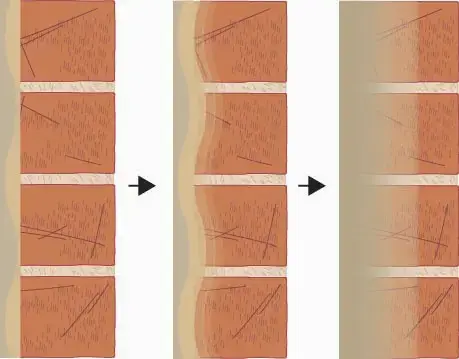
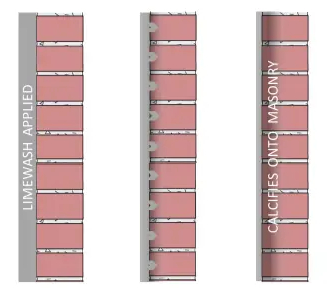
Wet paint applied to the brick at left penetrates into the brick, then permanently fuses into and onto the brick surface.

Silicification or “petrification” Principle: Mineral and lime-based paints do not just form a layer on the surface; they penetrate and chemically fuse to form a permanent bond deep within masonry and at the surface. This bond is irreversible, which explains the legendary, decades-long durability of these crystalline finishes.

Silicification: a chemical process where potassium silicate, the binder in silicate paints, forms a strong, lasting, and beautiful crystalline bond with mineral surfaces like stone, concrete, or brick. It's a remarkable transformation!

Silicification, or petrification, is the chemical-curing process used in mineral silicate paints. During this process, the binder—potassium silicate, also known as waterglass—undergoes a transformative reaction with mineral surfaces such as stone, concrete, or brick. This reaction forms an insoluble, permanent, and crystalline bond unmatched in durability. Unlike traditional paints, which merely form a film or layer on the surface, our mineral paints chemically fuse with the substrate. This integration ensures the paint becomes an integral part of the building material, effectively eliminating concerns such as peeling or blistering. 

Plus, it maintains breathability, allowing the surface to regulate moisture and air while delivering long-lasting protection.  
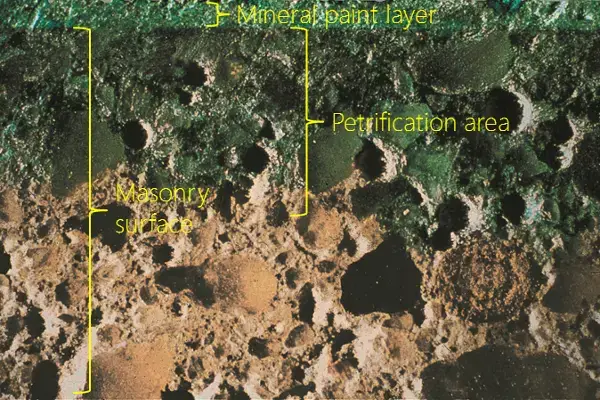
The image is a cross-section of masonry at 100X magnification. A mineral silicate paint was dyed green to visually demonstrate the binder's deep penetration. This represents a depth of approximately 10mm (0.4 inches). This area (marked by green dye) is where the chemical fusion occurs. The pigmented portion of the paint layer remains on the surface as a microcrystalline, stone-like layer that is both water-repellent and vapor-permeable (breathable) and, like stone, naturally resistant to weathering and UV.

Key aspects of Mineral Silicate chemical fusion

– Silicification: The binder of mineral paint penetrates the masonry and converts to silica, permanently binding the paint to the masonry.
– Carbon dioxide is consumed in the process, making these finishes low-carbon-emitting paints.
– “Liquid Stone”: The process transforms paint into a mineral-like, micro-crystalline structure that is highly durable and UV-resistant, similar to quartz in nature.
– Breathability (Vapor Permeable): Because the paint does not create a film or layer, it allows moisture to escape from the wall, reducing dampness.
– Longest-Lasting: The inorganic, mineral nature of the cured paint means it resists weathering and fading, often lasting for many decades.
– Surface Requirement: Fusion works on mineral-based materials like masonry, brick, plaster, stucco, stone, and concrete—it is not effective on wood. 

– Keim Mineral Masonry Paint is also suitable for use over previously latex/acrylic painted masonry. It should not be used over oil-based or extremely hard/glossy finishes like epoxy or urethane paints.
– Mineral paints can be used on terracotta, porcelain, glass, and non-ferrous metals with proper surface preparation.

– The inorganic structure is also resistant to high heat and can be used effectively on masonry that will become hot during use.
– Timeframe: Silicification is not instant and can take days or weeks to fully cure, depending on conditions. This is why it is recommended to wait overnight between coats of these finishes.  

Key aspects of Limewash carbonization

– Carbonization is the essential curing process of limewash, where calcium hydroxide (slaked lime) applied to a surface reacts with carbon dioxide (\(CO_{2}\)) in the atmosphere to revert back into calcium carbonate (limestone).
– This process transforms the liquid wash into a durable, breathable, and matte mineral finish that bonds chemically with porous substrates like brick, stone, and plaster. 
– Carbon dioxide and water are consumed in the process, making these finishes low-carbon emitting paints.
– The Chemical Cycle: Limewash begins as limestone, which is burned (calcination) to make quicklime, then mixed with water (slaking) to make lime putty. Upon application, the carbonization process reverses this, drawing \(CO_{2}\) from the air to turn the calcium hydroxide back into solid limestone.
– Timeframe: Carbonization is not instant and can take days or weeks to fully cure, depending on the surrounding moisture and air. It is recommended to allow at least 24 hours between coats for proper, initial carbonation.

– Moisture is Required: Carbonation can only take place in the presence of water. If the limewash dries too quickly, the process is disrupted, resulting in a weak, powdery finish.
– Application: surfaces must be dampened before application, and the work should be protected from rapid drying caused by wind or direct sunlight.

– Durability and Benefits: The carbonized layer is highly breathable, allowing moisture to escape, which prevents mold and mildew. It is a durable finish that, rather than peeling, will patina and harden over time.
– Troubleshooting: If the finish rubs off as dust, it is likely that the carbonation failed due to the surface drying too fast or being applied to a non-porous surface.
– Cracking: If applied too thick or in too heavy a coat, the limewash surface may crack, requiring it to be removed with hot water and a stiff brush.
– Temperature: Limewash should be applied in temperatures between 41°F and 86°F (5°C – 30°C). 

Properly applied and carbonized limewash can last 15–20 years on exterior surfaces and even longer on interior walls.

Limewash becomes part of your masonry.

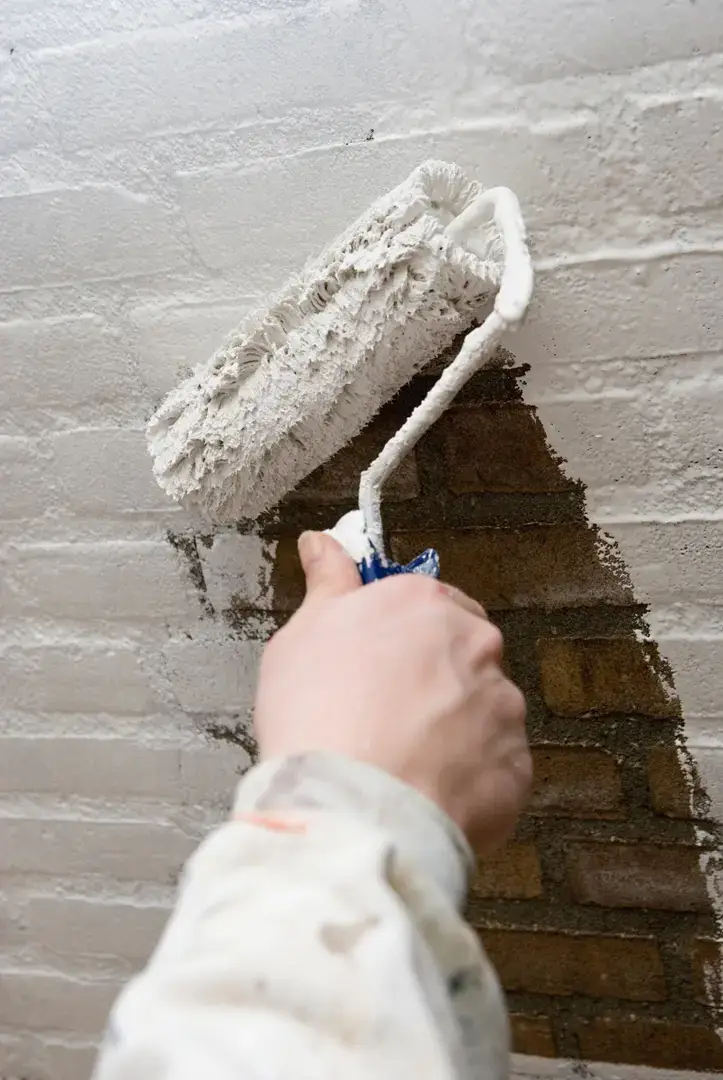
Limewash, applied on the left, penetrates porous brick and masonry, chemically bonding with the materials to become an integral part of them. Unlike ordinary paint, which merely forms a top layer and can chip, peel, or blister, limewash does not have these issues. Its crystalline structure allows moisture vapor that accumulates within the masonry to freely evaporate outdoors, ensuring that the limewash surface remains unharmed.

FAQs about mineral paint fusion

Fusing mineral and lime paint with masonry involves a permanent chemical reaction rather than the simple surface coating of an acrylic/latex paint. Here are some common questions.

What exactly is the "fusion" process?

The process is called silicification (or petrification). The potassium silicate binder in the paint penetrates deep into the masonry pores and reacts with the substrate’s mineral components (like calcium carbonate) to create covalent chemical bonds. This creates a microporous crystalline matrix that effectively “turns to stone” as it cures.

Fusion only occurs on porous mineral substrates (brick, stone, concrete, stucco). If a surface is already covered in acrylic paint, the mineral paint cannot reach the masonry to fuse. However, modern systems like KEIM Soldalit use “sol-silicate” technology to bond both chemically to mineral parts and physically to existing organic coatings.

Standard acrylic or latex paints are film-forming; they act like a “plastic glove” that sits on top of the surface. Mineral paints do not form a film. They become an integral part of the wall, which is why they do not peel, flake, or blister like traditional paints. Because it forms a crystalline structure rather than a solid plastic film, it is up to 6x more breathable than traditional coatings. This allows moisture vapor to escape freely while still protecting the wall from driving rain.

While standard paints may require a refresh every 5–10 years, mineral paint service life is measured in decades. Some original Keim applications have lasted over 100 years in Europe, without peeling or fading.

Yes, it enhances and protects previous paints. The sol silicate binder of mineral paints uses nano technology to bond both at the surface of existing paints and penetrates the paint layer to fuse with the masonry too. But, using mineral paint over acrylic/latex paints does not improve the vapor permeability of the existing paint. It does “freeze in time” the existing paint and protects it from UV degradation. The new mineral paint coating will also look fresh and clean much longer than traditional paint.

Extremely hard and glossy surfaces, such as epoxy and urethane paints, and oil-based paints, should not be repainted with mineral paints. Lime paint cannot be applied to any existing coating, as it must come into contact with bare masonry in order to carbonize (bond) properly. A mineral primer must be used with lime-based paints on existing painted surfaces.

In some situations, yes. On extremely dusty, sandy, or badly aged masonry, a silicate primer (or clear fixative) is used to consolidate the surface and ensure even suction, which helps the paint penetrate and react uniformly with the masonry. ContactPlus Bonding Primer is recommended to fill in small fissures, cracks, and voids in masonry, up to 1/32”, prior to finishing with mineral or lime-based paints.

No. Because mineral paints use inorganic mineral pigments that are UV-stable, the color is locked into the crystalline structure and will not degrade or yellow from sun exposure. The crystalline structure itself is also UV stable, and inert like quartz, and does not degrade in even the harshest sunlight.

IN HARMONY WITH NATURE AND CLIMATE

At KEIM, we view environmental protection as a promising opportunity for innovation and growth. Our deep commitment to sustainability drives us to develop solutions that seamlessly integrate with the natural world. Every detail of our sourcing, product design, production, packaging, and distribution processes is meticulously crafted with environmental stewardship at the forefront.

LOWERING OUR IMPACT BY CONSERVING RESOURCES

We are dedicated to creating sustainable products that minimize our environmental footprint. We recognize that sustained economic activity hinges upon the careful management of our natural resources. Emulating nature, we strive to utilize resources in a closed-loop system, ensuring maximum efficiency and sustainability. Our production facilities have been run on renewable solar power for many years, and we recycle and reuse every drop of water used in the crafting of our mineral paints, stains, and limewash. 

MINERALS PROVIDE AN EXCELLENT ECO-PROFILE

Our focus on low-impact construction and energy efficiency emphasizes the use of durable and non-toxic building materials, with safe disposal practices integrated into the circular economy. KEIM mineral paints stand out as the ideal choice, boasting exceptional properties throughout their lifecycle. Crafted from renewable, responsibly sourced materials, our products are made with minimal environmental impact. 
They are designed to endure for decades with simple maintenance, and their disposal requires no additional processing, aligning perfectly with sustainable practices. 

By choosing KEIM, you’re not just making a choice for quality, but also for a healthier planet.